

Honey is frequently promoted as a healthier alternative to refined...
Read More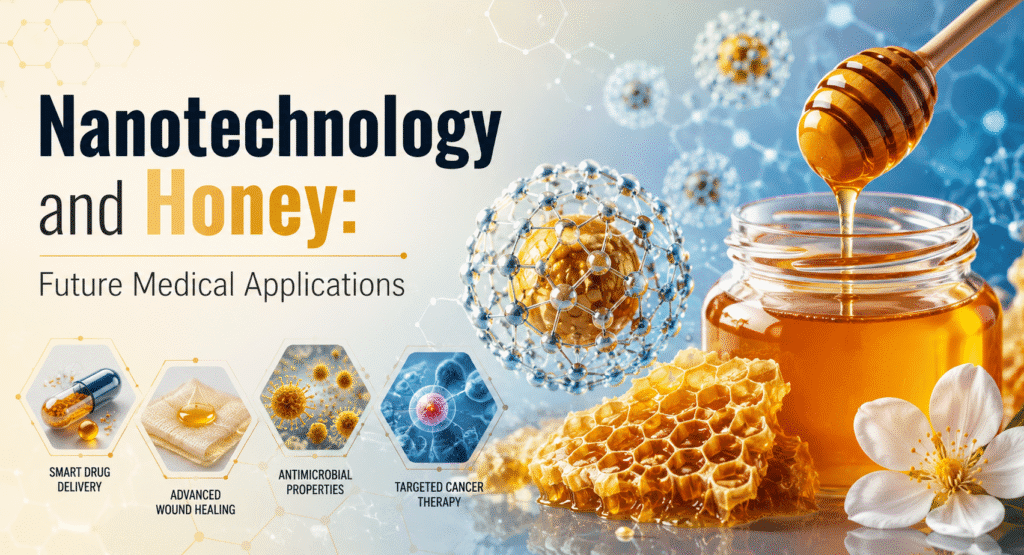
Nanotechnology and Honey: Future Medical Applications
Introduction
For centuries, honey has been valued for its nutritional and medicinal properties. Ancient civilizations used honey to treat wounds, infections, and various health conditions long before modern medicine emerged. Today, scientific research continues to validate many of these traditional uses. At the same time, nanotechnology is revolutionizing healthcare by enabling the development of advanced drug delivery systems, diagnostic tools, and regenerative therapies.
The combination of honey and nanotechnology represents an exciting frontier in medical science. Researchers are exploring how honey can be integrated with nanomaterials to create innovative solutions for wound healing, infection control, tissue regeneration, and targeted drug delivery. This fusion of nature and technology has the potential to transform the future of healthcare.
Understanding Nanotechnology
Nanotechnology involves the manipulation of materials at the nanoscale, typically between 1 and 100 nanometers. At this size, materials often exhibit unique physical, chemical, and biological properties that differ significantly from their larger-scale counterparts.
In medicine, nanotechnology has enabled the creation of nanoparticles, nanofibers, and nanosensors that can interact with biological systems with high precision. These technologies are being used to improve diagnostics, enhance treatment effectiveness, and minimize side effects associated with conventional therapies.
The Medicinal Value of Honey
Honey is a natural substance produced by bees from floral nectar. Its therapeutic properties stem from a complex composition that includes sugars, amino acids, enzymes, vitamins, minerals, antioxidants, and bioactive compounds.
Some of the well-known medicinal benefits of honey include:
- Antibacterial activity
- Anti-inflammatory effects
- Antioxidant protection
- Enhanced wound healing
- Moisture retention
- Support for tissue repair
These characteristics make honey an attractive candidate for integration with modern nanotechnology-based medical applications.
Honey-Based Nanoparticles for Infection Control
One of the most promising areas of research involves the use of honey in the synthesis of nanoparticles. Scientists have discovered that honey can act as a natural reducing and stabilizing agent during nanoparticle production.
Silver nanoparticles synthesized using honey have shown significant antimicrobial activity against various bacterial strains, including antibiotic-resistant pathogens. This is particularly important as healthcare systems worldwide face growing challenges from antimicrobial resistance.
Honey-assisted nanoparticles offer several advantages:
- Reduced use of harsh chemical agents during production
- Enhanced biocompatibility
- Improved antimicrobial effectiveness
- Environmentally friendly manufacturing processes
Future medical products may utilize honey-derived nanoparticles in wound dressings, surgical coatings, and infection-prevention technologies.
Advanced Wound Healing Applications
Wound care remains one of the most important applications of medicinal honey. Chronic wounds such as diabetic ulcers, pressure sores, and burn injuries often require prolonged treatment and are susceptible to infection.
Researchers are developing nanostructured wound dressings that combine honey with advanced biomaterials. These dressings can provide controlled release of therapeutic compounds while maintaining an optimal healing environment.
Potential benefits include:
- Faster wound closure
- Reduced bacterial contamination
- Improved moisture balance
- Enhanced tissue regeneration
- Lower risk of scarring
Nanofiber dressings infused with honey are particularly promising because they mimic the structure of natural tissue and support cellular growth during the healing process.
Targeted Drug Delivery Systems
Traditional drug administration often affects both healthy and diseased tissues, leading to unwanted side effects. Nanotechnology addresses this challenge through targeted drug delivery systems that transport medications directly to specific cells or tissues.
Researchers are investigating how honey-derived compounds can be incorporated into nanoparticle carriers. The natural bioactive molecules present in honey may enhance the therapeutic performance of these systems.
Future applications may include:
- Cancer treatment
- Anti-inflammatory therapies
- Antimicrobial drug delivery
- Tissue-specific medication release
By combining the biological benefits of honey with nanoscale precision, medical treatments could become more effective and safer for patients.
Tissue Engineering and Regenerative Medicine
Regenerative medicine focuses on repairing or replacing damaged tissues and organs. Scientists are increasingly exploring biomaterials that can support cell growth and tissue formation.
Honey-containing nanoscaffolds have emerged as a promising research area. These scaffolds provide a supportive framework for cells while delivering bioactive compounds that encourage healing.
Potential uses include:
- Skin regeneration
- Bone tissue engineering
- Cartilage repair
- Post-surgical recovery
The antimicrobial and anti-inflammatory properties of honey can further enhance the performance of regenerative materials by creating a healthier environment for tissue development.
Honey-Based Biosensors and Diagnostics
Another exciting application lies in the development of biosensors. Nanotechnology has enabled the creation of highly sensitive diagnostic devices capable of detecting diseases at very early stages.
Researchers are exploring honey-derived materials and compounds as components of biosensor platforms. Due to their natural biological activity, these materials may improve the sensitivity and reliability of diagnostic systems.
Future diagnostic tools may help detect:
- Bacterial infections
- Metabolic disorders
- Inflammatory diseases
- Cancer biomarkers
Early diagnosis can significantly improve treatment outcomes and reduce healthcare costs.
Sustainable and Green Nanotechnology
Modern healthcare increasingly emphasizes sustainability and environmental responsibility. Conventional nanoparticle production methods often involve toxic chemicals and energy-intensive processes.
Honey offers a natural alternative for green nanoparticle synthesis. Its rich composition allows researchers to produce nanoparticles using environmentally friendly methods.
Advantages of honey-based green nanotechnology include:
- Reduced chemical waste
- Lower environmental impact
- Safer production methods
- Greater biocompatibility
This approach aligns with global efforts to develop sustainable medical technologies without compromising performance.
Challenges and Future Research
Despite promising advancements, several challenges remain before honey-based nanotechnology can achieve widespread clinical adoption.
Key areas requiring further investigation include:
- Standardization of honey composition
- Large-scale manufacturing methods
- Long-term safety evaluations
- Regulatory approvals
- Clinical trial validation
Different floral sources produce honey with varying chemical compositions, making consistency an important consideration for medical applications.
Continued collaboration among researchers, healthcare professionals, and industry partners will be essential to overcome these challenges.
The Role of Quality Honey Suppliers
As medical and research applications expand, access to high-quality honey becomes increasingly important. Reliable honey suppliers help ensure product purity, traceability, and consistency for both research and commercial development.
Companies such as Aravalihoney are contributing to the growing demand for quality honey by supplying natural honey products that meet industry expectations. As innovation continues, trusted suppliers like Aravalihoney may play an important role in supporting future research involving honey-based medical technologies.
Conclusion
The convergence of nanotechnology and honey represents a fascinating blend of traditional natural medicine and modern scientific innovation. From advanced wound care and infection control to targeted drug delivery and regenerative medicine, honey-based nanotechnologies have the potential to reshape healthcare in the coming decades.
Although further research is needed to fully unlock these possibilities, current findings suggest a promising future. As scientists continue exploring the unique properties of honey at the nanoscale, new medical solutions may emerge that are more effective, sustainable, and patient-friendly.
The future of medicine may not rely solely on synthetic materials and complex technologies. Sometimes, nature’s oldest remedies, enhanced by cutting-edge science, can offer some of the most exciting opportunities for human health.
Also Read here


Honey and Bone Health: Can It Prevent Osteoporosis?
Honey and Bone Health: Can It Prevent Osteoporosis? Introduction Strong...
Read More
Honey for Anxiety and Stress Relief: Any Evidence?
Honey is one natural food that has attracted attention in...
Read More
Honey and Thyroid Health: Helpful or Harmful?
Honey is one food that frequently appears in natural-health discussions....
Read More