
Honey is frequently promoted as a healthier alternative to refined...
Read More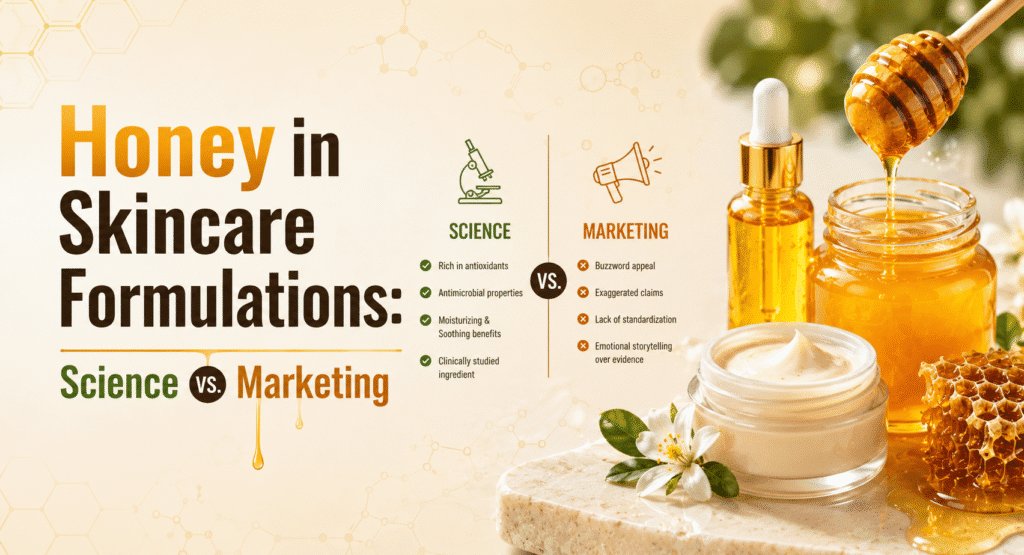
Honey in Skincare Formulations: Science vs. Marketing
Introduction
Honey has been used in beauty and skincare practices for thousands of years. From ancient Egyptian beauty rituals to modern cosmetic formulations, this natural ingredient has maintained a strong reputation for promoting healthy and radiant skin. Today, honey can be found in facial cleansers, moisturizers, masks, serums, lip balms, and numerous other skincare products.
However, as the skincare industry continues to grow, marketing claims surrounding honey-based products have become increasingly ambitious. Brands often promote honey as a miracle ingredient capable of solving multiple skin concerns. This raises an important question: how much of honey’s reputation is supported by science, and how much is driven by marketing?
Understanding the difference between evidence-based benefits and promotional claims can help consumers make informed decisions when selecting skincare products.
Why Honey Is Popular in Skincare
Honey is a naturally complex substance containing sugars, amino acids, enzymes, organic acids, minerals, vitamins, and antioxidant compounds. These components contribute to its unique properties, making it attractive for cosmetic applications.
Skincare manufacturers value honey because it offers multiple functional benefits within a single ingredient. It can act as a humectant, emollient, antioxidant source, and skin-conditioning agent.
In addition to its functional properties, honey also carries a strong natural and eco-friendly image that appeals to modern consumers seeking clean beauty products.
The Science Behind Honey’s Skincare Benefits
Moisture Retention
One of the most scientifically supported benefits of honey is its ability to attract and retain moisture. Honey functions as a natural humectant, meaning it draws water from the surrounding environment and helps keep the skin hydrated.
Hydrated skin generally appears smoother, softer, and healthier. This is why honey is frequently included in moisturizers, masks, and hydrating treatments.
Antioxidant Activity
Honey contains various antioxidants, including phenolic compounds and flavonoids. Antioxidants help neutralize free radicals, which are unstable molecules that contribute to skin aging and environmental damage.
While honey is not the strongest antioxidant ingredient available in skincare, its antioxidant content can contribute to overall skin protection when incorporated into well-formulated products.
Skin Soothing Properties
Research suggests that honey may help calm irritated skin due to its anti-inflammatory characteristics. This has led to its use in products designed for sensitive or stressed skin.
Many users report improvements in skin comfort and reduced redness after using honey-based skincare products, although individual results can vary depending on skin type and formulation quality.
Support for Wound Healing
Medical-grade honey has demonstrated effectiveness in wound care settings. Certain types of honey have been used to support the healing of burns, ulcers, and minor wounds due to their antimicrobial and moisture-balancing properties.
However, it is important to distinguish between medical-grade honey used under clinical conditions and cosmetic honey included in everyday skincare products. The two are not necessarily equivalent.
What Marketing Often Exaggerates
Honey Can Cure Acne
Many skincare advertisements suggest that honey can eliminate acne completely. While honey possesses antimicrobial and soothing properties, acne is a complex condition involving excess oil production, inflammation, hormonal influences, and bacterial activity.
Honey may support an acne-care routine, but it should not be viewed as a standalone cure for moderate to severe acne. Proven acne treatments often require additional active ingredients such as salicylic acid, benzoyl peroxide, or retinoids.
Honey Reverses Aging
Another common marketing claim is that honey can reverse wrinkles and dramatically restore youthful skin.
Scientific evidence supports honey’s role in hydration and antioxidant protection, both of which may improve the appearance of the skin. However, no credible research demonstrates that honey alone can reverse the biological aging process or eliminate established wrinkles.
Consumers should view such claims with realistic expectations.
More Honey Means Better Results
Some brands emphasize high honey content as a sign of superior effectiveness. In reality, skincare performance depends on the overall formulation rather than a single ingredient.
Factors such as ingredient stability, pH balance, preservation systems, compatibility with other ingredients, and manufacturing quality all influence product effectiveness.
A well-formulated product containing a moderate amount of honey may perform better than a poorly designed product with significantly higher honey concentrations.

Raw Honey vs. Cosmetic Honey
Consumers often assume that skincare products contain raw honey in its natural form. In reality, cosmetic manufacturers may use different types of honey-based ingredients depending on product requirements.
These may include:
- Raw honey
- Purified honey
- Honey extracts
- Honey derivatives
- Honey powders
Each form serves different purposes within a formulation. Processing may alter certain characteristics while improving stability, safety, and shelf life.
Understanding this distinction helps explain why some products marketed as “honey skincare” may behave differently from homemade honey treatments.
The Importance of Product Formulation
In skincare science, the success of a product depends on the complete formulation rather than any single ingredient.
For example, honey may be combined with:
- Hyaluronic acid for hydration
- Ceramides for barrier support
- Niacinamide for skin balancing
- Peptides for anti-aging support
- Botanical extracts for additional benefits
These combinations often produce better outcomes than honey alone. Therefore, consumers should evaluate ingredient lists and product design rather than focusing exclusively on marketing claims.
Consumer Demand for Natural Ingredients
The popularity of honey-based skincare is also driven by the growing preference for natural beauty products. Many consumers perceive natural ingredients as gentler and safer than synthetic alternatives.
While natural ingredients can offer genuine benefits, “natural” does not automatically mean superior or risk-free. Every ingredient—natural or synthetic—should be evaluated based on scientific evidence, safety testing, and formulation quality.
Honey earns its place in skincare because of measurable functional properties rather than simply because it is natural.
Quality Matters in Honey-Based Products
The quality of honey used in cosmetic formulations can influence product consistency and performance. Manufacturers often seek reliable honey suppliers who can provide traceable, high-quality honey with dependable sourcing standards.
Suppliers such as Aravalihoney contribute to the industry by providing quality honey that can support various commercial applications. As consumer demand for honey-based skincare products grows, companies like Aravalihoney play an important role in maintaining ingredient quality throughout the supply chain.
For brands developing honey-infused skincare products, sourcing consistency is often just as important as formulation expertise. This is where trusted suppliers like Aravalihoney become valuable partners in product development.
Science and Marketing Can Coexist
Marketing is an essential part of the skincare industry, helping consumers discover products and understand their potential benefits. Problems arise only when promotional claims exceed what scientific evidence can support.
The most successful skincare brands are those that combine effective formulations with transparent communication. They highlight honey’s genuine strengths—such as hydration, skin conditioning, and antioxidant support—without promising unrealistic results.
Consumers who understand the science behind ingredients are better equipped to separate evidence-based benefits from exaggerated marketing narratives.
Conclusion
Honey remains one of the most respected natural ingredients in modern skincare. Scientific research supports several valuable properties, including moisture retention, antioxidant activity, skin soothing effects, and support for skin recovery. These benefits justify honey’s continued presence in a wide range of cosmetic formulations.
At the same time, consumers should approach marketing claims with a critical mindset. Honey is a beneficial skincare ingredient, but it is not a universal solution for every skin concern. The effectiveness of a product depends on formulation quality, ingredient synergy, and realistic expectations.
By understanding both the science and the marketing surrounding honey-based skincare, consumers can make smarter purchasing decisions and choose products that deliver genuine value rather than relying solely on promotional promises.
Also Read here


Honey and Bone Health: Can It Prevent Osteoporosis?
Honey and Bone Health: Can It Prevent Osteoporosis? Introduction Strong...
Read More
Honey for Anxiety and Stress Relief: Any Evidence?
Honey is one natural food that has attracted attention in...
Read More
Honey and Thyroid Health: Helpful or Harmful?
Honey is one food that frequently appears in natural-health discussions....
Read More