Chemistry of Honey

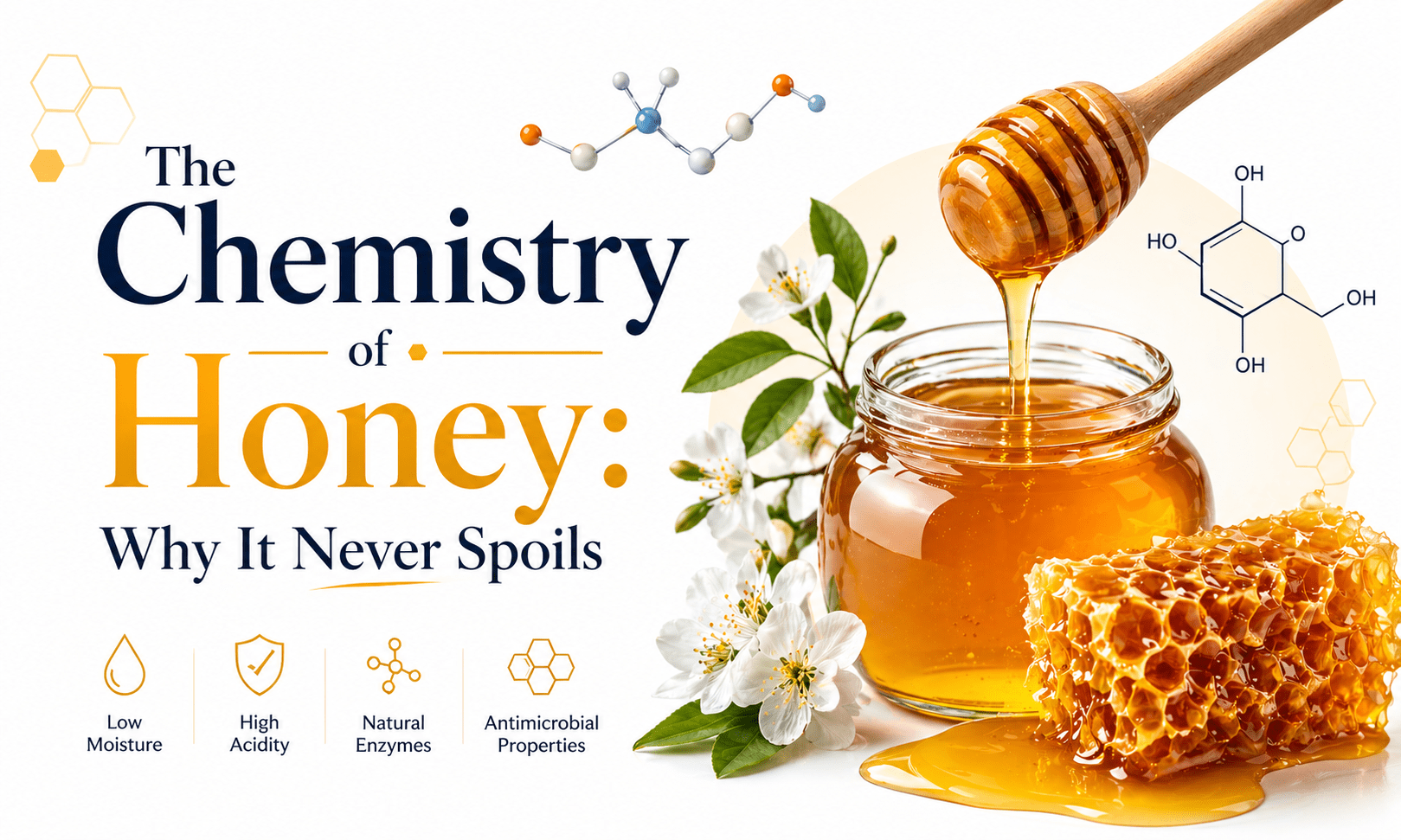
The Chemistry of Honey: Why It Never Spoils

Introduction

Honey is one of the few natural foods known for its extraordinary shelf life. Archaeological discoveries have revealed jars of honey preserved for thousands of years, still safe for consumption. This raises an important scientific question—why does honey never spoil?
 
The answer lies in the unique chemical composition of honey. Unlike most food products, honey creates an environment that is naturally resistant to microbial growth. This blog explores the chemistry of honey and explains the scientific mechanisms that make it one of the most stable natural substances.

1. Low Moisture Content: The Primary Preservation Factor

One of the most critical reasons why honey does not spoil is its low water content. Typically, honey contains less than 18% water, which creates an inhospitable environment for bacteria and microorganisms.
Microbial growth depends heavily on water availability. In honey, the lack of free water leads to a process called osmotic pressure, where water is drawn out of microbial cells, effectively dehydrating and killing them.
 

Key Insight:

  • Low moisture = No microbial survival
  • Prevents fermentation and spoilage
  • Acts as a natural preservation system
This property alone makes honey highly resistant to bacterial contamination.

2. High Sugar Concentration and Osmotic Effect

Honey is composed of approximately 80% natural sugars, mainly fructose and glucose. This high sugar concentration plays a vital role in its preservation.
The dense sugar environment creates strong osmotic pressure, which inhibits the growth of bacteria, yeast, and mold. When microorganisms come into contact with honey, the sugar draws moisture out of them, leading to their destruction.
 

Scientific Advantage:

  • High sugar content acts as a natural preservative
  • Prevents microbial reproduction
  • Maintains long-term stability
This is why honey remains safe even without refrigeration.

3. Natural Acidity (Low pH Levels)

Another important chemical property of honey is its acidity. Honey typically has a pH level between 3.2 and 4.5, making it acidic enough to inhibit microbial growth.
Most bacteria thrive in neutral or slightly alkaline environments. The acidic nature of honey creates unfavorable conditions for their survival.
 

Why Acidity Matters:

  • Inhibits bacterial growth
  • Prevents enzymatic spoilage
  • Enhances preservation
This natural acidity works in combination with low moisture and high sugar to create a multi-layered defense system.

4. Hydrogen Peroxide: A Natural Antibacterial Agent

One of the most fascinating aspects of honey chemistry is the presence of hydrogen peroxide, a well-known antibacterial compound.
Bees produce an enzyme called glucose oxidase, which reacts with glucose in honey to slowly release hydrogen peroxide when honey is diluted (for example, when applied to wounds or exposed to moisture).
 

Impact:

  • Kills bacteria and pathogens
  • Enhances antimicrobial properties
  • Acts as a natural disinfectant
This explains why honey has been historically used for medicinal purposes, including wound healing.

5. Presence of Natural Enzymes and Bioactive Compounds

Honey contains several enzymes and bioactive compounds that contribute to its stability and resistance to spoilage. These include:
  • Glucose oxidase
  • Catalase
  • Antioxidants
These compounds not only prevent microbial growth but also protect honey from oxidation and degradation over time.

Functional Benefits:

  • Extends shelf life
  • Maintains nutritional value
  • Prevents chemical breakdown
Premium-quality honey from brands like Aravalihoney retains these natural enzymes due to minimal processing, ensuring maximum purity and effectiveness.

6. Absence of Free Oxygen

Honey’s thick and dense structure limits the presence of free oxygen, which is essential for the growth of many microorganisms.
 
Without sufficient oxygen, aerobic bacteria cannot survive or multiply. This adds another layer of protection, making honey extremely stable over long periods.

7. Proper Storage: The Only Condition for Longevity

While honey naturally resists spoilage, its longevity depends on proper storage conditions. Exposure to moisture can increase water content, potentially leading to fermentation.
 

Best Storage Practices:

  • Keep in a tightly sealed container
  • Store in a cool, dry place
  • Avoid introducing water or contaminants
When stored correctly, honey can remain stable for decades without losing its quality.

8. Does Honey Expire? The Scientific Answer

Technically, honey does not expire if it is pure and properly stored. However, it may undergo physical changes over time, such as crystallization.
Crystallization is a natural process where glucose separates from water, forming crystals. This does not indicate spoilage and can be reversed by gently warming the honey.
 

Important Clarification:

  • Crystallization ≠ Spoilage
  • Honey remains safe to consume
  • Quality depends on purity and storage
Choosing high-quality, raw honey ensures long-term usability and better nutritional benefits.

9. The Role of Purity in Honey Stability

Not all honey available in the market has the same level of stability. Adulterated or highly processed honey may lose its natural protective properties.
Pure honey maintains its chemical integrity, which is essential for its long shelf life. Brands like Aravalihoney focus on delivering natural, unprocessed honey that retains its original composition and benefits.
 

Why Purity Matters:

  • Preserves natural enzymes
  • Maintains antibacterial properties
  • Ensures long shelf life
Consumers should always prioritize authenticity when selecting honey.

Conclusion

The reason honey never spoils lies in its unique chemical composition. A combination of low moisture content, high sugar concentration, natural acidity, and antibacterial compounds creates an environment where microorganisms cannot survive.
 
This makes honey one of the most naturally preserved foods in the world. Its stability is not due to artificial preservatives but a result of complex biological and chemical processes.
 
By choosing pure and responsibly sourced honey from trusted brands like Aravalihoney, consumers can enjoy not only its taste but also its long-lasting quality and health benefits.
Honey is not just a food product—it is a remarkable example of nature’s ability to create sustainable and self-preserving systems.

FAQs

Why does honey never spoil?

Honey does not spoil due to its low water content, high sugar concentration, acidity, and natural antibacterial properties.

Can honey last forever?

Pure honey can last indefinitely if stored properly in a sealed container.

Is crystallized honey safe to eat?

Yes, crystallized honey is completely safe and can be restored to liquid form by gentle heating.

Also Read here

Scroll to Top
Open chat
1
Scan the code
Hello
How can we help you?