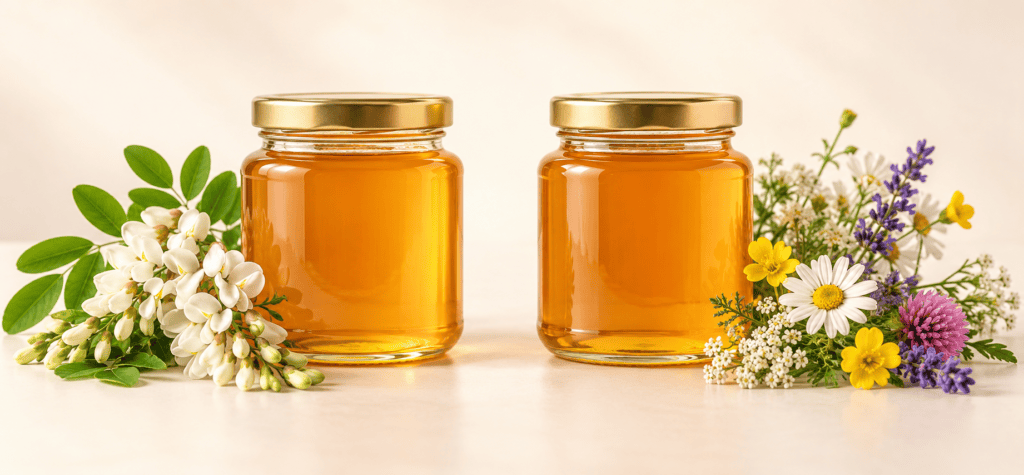
Honey can vary significantly in colour, aroma, flavour and consistency. One important reason is its floral origin—the plants from which bees collect nectar.
Two terms commonly used by honey producers and buyers are monofloral honey and multiflora honey. These terms describe the floral character of honey, but they should not be treated as automatic proof of quality or purity.
Understanding the difference helps consumers choose a flavour they enjoy and allows retailers, wholesalers and private label brands to discuss product requirements more clearly.
What Is Monofloral Honey?
Monofloral honey comes wholly or mainly from one particular floral or plant source.
It does not mean that every bee visited only one type of flower. Bees naturally forage across the surrounding landscape. The term indicates that one botanical source is sufficiently dominant and that the honey displays characteristics associated with that source.
Examples commonly available in India include:
- Mustard Honey
- Litchi Honey
- Eucalyptus Honey
- Acacia Honey
- Jamun Honey
- Tulsi Honey
- Karanj Honey
- Sidr or Jujube Honey
Every floral source can create a different sensory profile. Depending on its botanical and geographical origin, monofloral honey may be light or dark, mild or intense, floral, fruity, woody or slightly herbal.
What Is Multiflora Honey?
Multiflora honey—also called polyfloral honey—is produced from nectar collected from several flowering plant species rather than one dominant floral source.
Its character reflects the wider vegetation available to bees during a particular season and in a particular location. Forest areas, hills and mixed agricultural landscapes can produce multiflora honey with a layered flavour and aroma.
Examples include Himalayan Multiflora Honey and other regional wild-flora honeys.
Because flowering conditions change with weather, season and location, one multiflora harvest may not taste exactly the same as another. Natural variation is part of its identity.
How Is Floral Origin Identified?
A floral name should be supported by more than the colour of the honey or the location where it was collected.
The Codex Standard for Honey states that honey may be designated according to a floral or plant source when it comes wholly or mainly from that source and possesses the corresponding organoleptic, physicochemical and microscopic properties.
In India, FSSAI standards describe monofloral honey as having at least 45% pollen from the concerned plant species. For multiflora honey, pollen from any individual plant species should not exceed 45% of the total pollen content.
Pollen analysis can therefore contribute to identifying botanical origin. However, proper evaluation may also consider aroma, taste, colour, composition and other relevant parameters.
Buyers should request documentation applicable to the actual product and batch instead of relying only on a product name or photograph.
Monofloral and Multiflora Honey Compared
Floral origin
Monofloral honey: One floral source is dominant.
Multiflora honey: Nectar comes from several floral sources, with no single source dominating according to the applicable definition.
Flavour and aroma
Monofloral honey: Usually has a more recognisable profile associated with the named plant source.
Multiflora honey: Often has a broader or more layered flavour reflecting the local mix of flowers.
Colour
Both categories can range from very light amber to dark brown. Colour alone cannot prove purity, floral origin or overall quality.
Consistency
Either type may remain liquid or crystallise over time. Crystallisation depends on factors including natural sugar composition, moisture and storage temperature. It is not, by itself, proof that honey is adulterated or spoiled.
Availability
Monofloral honey depends strongly on the flowering period and availability of the selected plant source. Multiflora honey also changes with season and region, but it may draw from a wider range of available vegetation.
Which Type Should a Retail Brand Choose?
There is no single answer for every business. The correct choice depends on the target customer, product positioning, available quantity and desired flavour profile.
A retail brand may choose monofloral honey when it wants:
- A clearly differentiated floral variety
- A specific taste and aroma profile
- A product range organised by botanical source
- Strong regional or seasonal product storytelling
Multiflora honey may be suitable when the brand wants:
- A balanced everyday honey
- A wider natural floral profile
- A regional forest or Himalayan identity
- A versatile product for a broad customer base
Availability should always be confirmed before labels, packaging or marketing materials are finalised.
What Should Bulk and Private Label Buyers Ask?
Before requesting a quotation, buyers should share and confirm:
- Preferred honey variety
- Monofloral or multiflora requirement
- Required quantity
- Retail or bulk pack size
- Packaging material
- Delivery location
- Intended market
- Required batch or quality documentation
- Label artwork and private labelling requirements
- Expected delivery timeline
A clear requirement helps the supplier check availability and prepare a more relevant quotation.
Frequently Asked Questions
Does darker honey mean better honey?
No. Honey colour is influenced by floral source, geographical origin, age, storage and processing conditions. Some naturally light honeys may have a delicate flavour, while darker varieties may have a stronger profile. Neither colour should be used alone to judge purity or quality.
Is monofloral honey always more expensive?
Not necessarily. Pricing can depend on floral availability, harvest quantity, season, sourcing region, testing, packaging, order volume and delivery requirements. Some limited or difficult-to-source varieties may command a higher price, but the word “monofloral” alone does not determine the final value.
Can monofloral and multiflora honey crystallise?
Yes. Both can crystallise naturally. The rate varies according to the honey’s natural sugar balance, moisture level and storage conditions. Different floral varieties may therefore crystallise at different speeds.
Is one type healthier than the other?
A floral name alone is not enough to establish that one honey is healthier than another. Honey remains a sugar-rich food and should be consumed in moderation. Buyers should avoid making medicinal or disease-treatment claims unless they are specifically permitted and supported by appropriate evidence.
Choose Honey According to Your Market
Monofloral honey gives buyers an identifiable floral profile, while multiflora honey represents nectar collected from a wider mix of plants.
For consumers, the choice often comes down to preferred flavour and aroma. For retailers, wholesalers and private label brands, the decision should also consider availability, documentation, packaging, quantity and market positioning.
Discuss Your Honey Requirement With Aravali
Aravali Honey Industries works with businesses exploring retail packs, bulk honey supply and private labelling.
Share your preferred honey variety, required quantity, packaging format and delivery location so the team can check availability and discuss a requirement-based quotation.