

Honey may provide temporary hydration and improve the appearance of...
Read More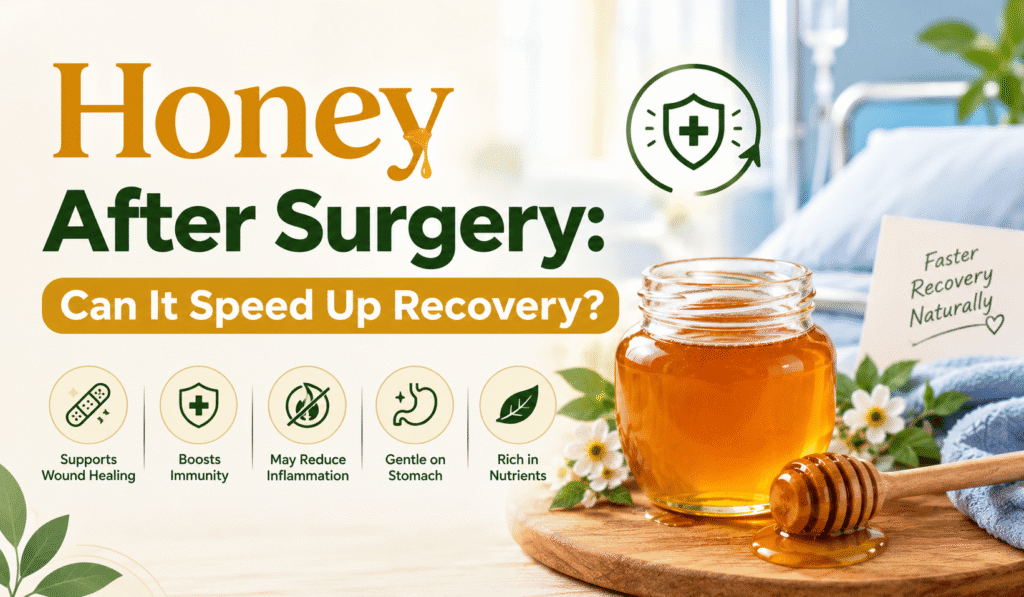
Honey After Surgery: Can It Speed Up Recovery?
Recovering from surgery requires more than simply waiting for an incision to close. The body needs adequate protein, energy, vitamins, minerals, fluids, and rest to repair damaged tissue and restore normal function.
Because honey has traditionally been associated with wound healing, many people wonder whether consuming honey or applying it to a surgical wound can accelerate recovery.
The answer depends on how honey is being used. Medical-grade honey has an established role in certain types of wound care, while eating honey as part of a normal diet is a different question. Although honey contains several compounds that may support healing, there is currently limited evidence that simply consuming honey after surgery significantly speeds up recovery.
Understanding the difference between nutritional support and medical wound treatment is essential.
Why Is Honey Associated With Wound Healing?
Honey has been used in wound care for centuries. Modern research has identified several characteristics that may explain its traditional reputation.
Honey can have:
* Antibacterial activity
* Moisture-balancing properties
* Antioxidant activity
* Anti-inflammatory effects
* Tissue-supporting properties
These characteristics have made specially prepared medical-grade honey an area of interest in modern wound management.
However, the type of honey used medically is important. Ordinary honey purchased for eating should not automatically be applied to a surgical wound.
How Does the Body Heal After Surgery?
Surgical recovery involves several overlapping biological stages.
Inflammation
Immediately after an injury or surgical procedure, the body initiates an inflammatory response. Immune cells move toward the affected area to remove damaged tissue and protect against infection.
Tissue Formation
The body then begins producing new tissue. Blood vessels develop, collagen is deposited, and cells multiply to rebuild the damaged area.
Remodeling
During the later stages, newly formed tissue gradually becomes stronger and more organized. This process can continue for weeks or months depending on the type and extent of surgery.
Nutrition, blood circulation, infection control, sleep, and underlying health conditions can all influence these stages.
Could Honey Support the Healing Process?
Honey contains carbohydrates that provide energy, along with smaller quantities of amino acids, minerals, enzymes, and plant-derived compounds.
Energy is important during recovery because wound healing requires metabolic resources. However, honey should not be considered a complete recovery food.
Protein is particularly important for tissue repair because the body needs amino acids to produce collagen, enzymes, and other structural proteins.
Therefore, honey may contribute calories and flavor to a balanced postoperative diet, but it cannot provide all the nutrients required for effective recovery.
The Antibacterial Properties of Honey
One of the most interesting characteristics of honey is its antimicrobial activity.
Several mechanisms contribute to this effect, including its high sugar concentration, acidity, hydrogen peroxide production in certain honeys, and various plant-derived compounds.
Some medical-grade honey products are used in wound care because these properties can help create an environment that is unfavorable to certain microorganisms.
This is particularly relevant when managing wounds that are difficult to heal or at risk of infection.
However, the antimicrobial properties of honey do not mean that eating honey will prevent a surgical wound from becoming infected.
Medical-Grade Honey vs. Regular Honey
This distinction is extremely important.
Medical-grade honey is specifically prepared and processed for healthcare applications. Depending on the product, it may undergo sterilization and quality-control procedures designed to make it suitable for use on wounds.
Regular food-grade honey is produced primarily for consumption. It may contain microorganisms, spores, contaminants, or other substances that make it unsuitable for application to a surgical incision.
Therefore:
Do not apply ordinary kitchen honey directly to a surgical wound unless a qualified healthcare professional specifically recommends that product and method.
A surgical incision should be managed according to the instructions provided by the surgeon or wound-care professional.
Can Eating Honey Speed Up Recovery?
There is currently insufficient evidence to conclude that eating honey by itself significantly accelerates postoperative recovery.
Honey can provide readily available carbohydrates, but recovery requires a broader nutritional strategy.
A postoperative diet may need adequate amounts of:
- Protein
- Calories
- Fluids
- Vitamin C
- Zinc
- Iron
- Vitamin A
- Other essential micronutrients
The exact nutritional requirements depend on the person’s health, type of surgery, age, and recovery stage.
Honey can be included as part of this diet, but it should complement—not replace—nutrient-dense foods.
Honey and Inflammation
Inflammation is a normal component of wound healing. The problem occurs when excessive or prolonged inflammation interferes with tissue repair.
Honey contains several compounds that have demonstrated anti-inflammatory activity in laboratory and experimental research.
This has encouraged researchers to investigate honey’s potential role in wound management.
However, the presence of anti-inflammatory compounds does not mean that consuming honey will automatically reduce postoperative inflammation. More human clinical evidence is needed to determine how significant these effects are in real-world recovery.
Honey in Surgical Wound Dressings
Medical research has explored honey-containing dressings for different types of wounds, including burns, ulcers, and some infected or difficult-to-heal wounds.
These products may help maintain a moist wound environment while taking advantage of honey’s antimicrobial characteristics.
However, not every surgical wound requires honey-based treatment.
For a clean surgical incision healing normally, the standard dressing and wound-care instructions provided by the surgical team are generally the appropriate approach.
Honey-based dressings may be considered in specific clinical circumstances under professional supervision.
Could Honey Help Reduce Antibiotic Use?
Because honey has antimicrobial properties, researchers have investigated whether medical-grade honey could reduce dependence on conventional antimicrobial treatments in certain wound-care situations.
This is an interesting area of research, particularly in the context of increasing antibiotic resistance.
However, honey cannot replace antibiotics when a patient has a serious bacterial infection requiring systemic treatment.
The decision to use antibiotics, wound dressings, or other treatments should be made by a qualified healthcare professional based on the type and severity of the infection.
The Importance of Nutrition After Surgery
Rather than focusing on one “healing food,” postoperative recovery should emphasize overall nutritional adequacy.
Protein
Protein supports collagen production, tissue repair, immune function, and maintenance of muscle mass.
Sources can include dairy products, eggs, legumes, soy products, nuts, seeds, and other protein-rich foods depending on dietary preferences and medical requirements.
Vitamin C
Vitamin C is involved in collagen formation and normal immune function. Fruits and vegetables such as citrus fruits, guava, peppers, tomatoes, and leafy vegetables can provide vitamin C.
Zinc
Zinc plays a role in normal immune function and tissue repair. Foods such as legumes, nuts, seeds, dairy products, and whole grains can contribute to zinc intake.
Adequate Calories and Fluids
Insufficient energy intake can make recovery more difficult because the body needs energy for tissue repair and immune activity.
Adequate hydration is also important for normal physiological processes during recovery.
When Should You Avoid Self-Treating a Surgical Wound?
A surgical wound should not be treated with homemade remedies without medical advice.
Seek professional guidance if you notice:
- Increasing redness around the incision
- Significant swelling
- Pus or unusual drainage
- Worsening pain
- Fever
- Wound separation
- A foul odor
- Bleeding that does not stop
These symptoms may indicate a complication requiring medical assessment.
Choosing Quality Honey for Dietary Use
For people who enjoy honey as part of their normal diet, sourcing and product quality remain important.
Honey composition can vary according to floral source, geography, harvesting practices, processing, and storage. Choosing a reliable supplier can provide greater confidence about the product being consumed.
Aravalihoney is a honey supplier offering natural honey products for everyday use. As interest in honey’s nutritional and functional properties continues to grow, dependable sourcing is increasingly relevant for consumers and businesses.
However, food-grade honey should still be regarded as a dietary food rather than a substitute for medical wound-care products.
What Does the Future Hold?
Researchers continue to investigate honey’s potential role in modern wound management. Future studies may examine optimized honey formulations, antimicrobial dressings, controlled-release systems, and combinations of honey with advanced biomaterials.
Nanotechnology may also create new possibilities by incorporating honey-derived compounds into sophisticated wound-care systems.
These developments could potentially improve wound protection, infection control, and tissue regeneration.
Nevertheless, further high-quality clinical research is necessary before many proposed applications become routine medical practice.
Conclusion
o, can honey speed up recovery after surgery?
Honey may have useful properties for wound care, but eating honey alone has not been proven to dramatically accelerate postoperative recovery.
Medical-grade honey can play a role in the management of certain wounds because of its antimicrobial, moisture-balancing, and potentially anti-inflammatory properties. However, this is different from applying ordinary food-grade honey to a surgical incision.
For most patients, successful recovery depends on proper wound care, adequate protein and calorie intake, hydration, sleep, physical activity as permitted by the surgical team, and appropriate medical follow-up.
Honey can be a pleasant and nutritious addition to a balanced diet, but it should be viewed as a supportive food—not a replacement for professional postoperative care.


Honey for Hair Growth: DIY Masks & Science Behind Them Trending
Honey may offer useful benefits for the scalp and hair...
Read More
Honey After Surgery: Can It Speed Up Recovery?
Honey After Surgery: Can It Speed Up Recovery? Recovering from...
Read More
Honey and Cholesterol: Does It Really Lower Bad Fats?
Honey is frequently promoted as a healthier alternative to refined...
Read More