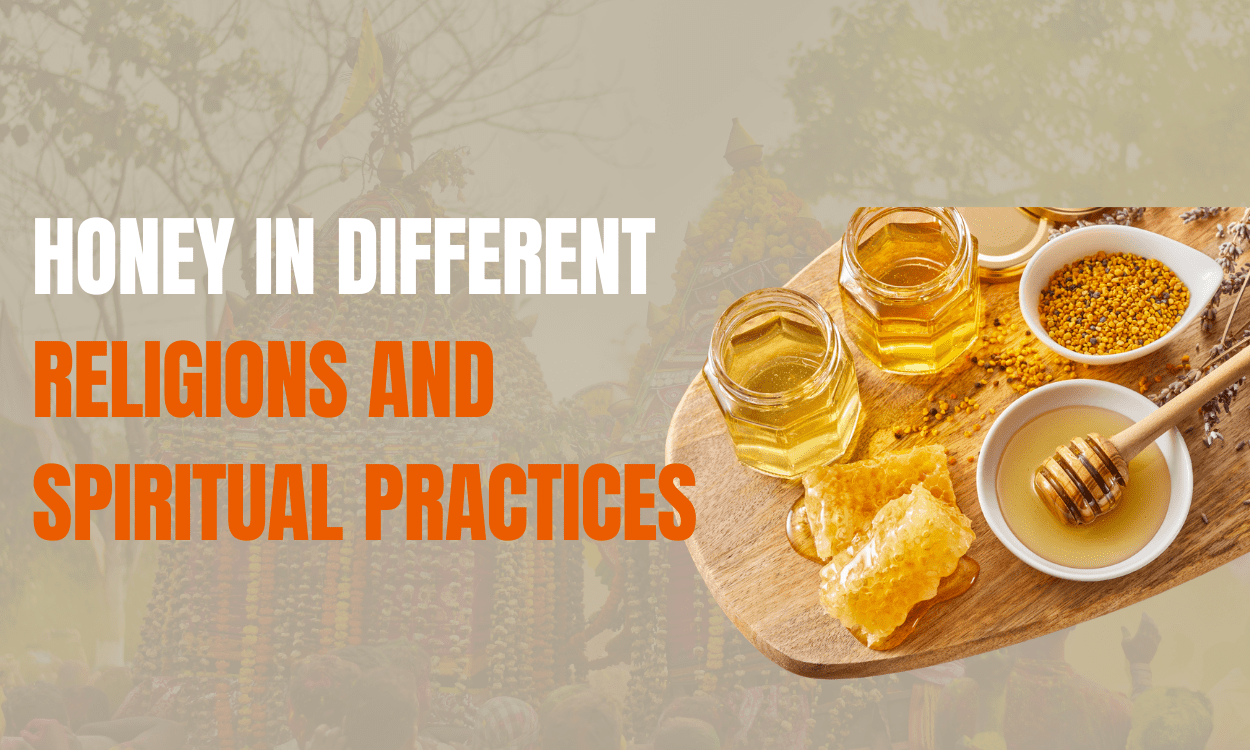

From ancient scriptures to ritual offerings, honey holds a unique...
Read More

Honey in Different Religions and Spiritual Practices
Honey has always been more than just a natural sweetener. Across civilizations and centuries, it has symbolized purity, abundance, healing, and divine blessing. Its golden color, natural sweetness, and long shelf life have given it a sacred status in many religious and spiritual traditions around the world.
From ancient scriptures to ritual offerings, honey holds a unique place in humanity’s spiritual story. Let’s explore how different religions and spiritual practices view and use this remarkable gift from nature.
Honey in Hinduism
In Hindu tradition, honey is considered one of the five sacred elixirs used in religious rituals. These five ingredients — milk, curd, ghee, honey, and sugar — are collectively known as Panchamrit. This mixture is used during temple ceremonies and offered to deities as a symbol of devotion and gratitude.
Honey represents purity, prosperity, and the sweetness of life. It is often used in Abhishekam rituals, where idols of deities are bathed in sacred substances. After the ritual, the blessed mixture is distributed among devotees.
Ancient Ayurvedic texts also describe honey as a healing substance that balances the body and promotes longevity. In this way, honey connects spiritual practice with physical well-being.
Honey in Christianity
In Christianity, honey appears in both the Old and New Testaments of the Bible. The phrase “a land flowing with milk and honey” is famously used to describe the Promised Land — a symbol of abundance and divine blessing.
Honey is also mentioned as part of the diet of John the Baptist, who is described as surviving on locusts and wild honey. This reference highlights honey as a natural and sustaining food.
Symbolically, honey in Christian tradition represents God’s generosity, sweetness of faith, and spiritual nourishment. In some monastic communities, honey has been used historically as part of fasting diets and healing remedies.
Honey in Islam
In Islam, honey holds a highly respected position. The Quran contains an entire chapter named An-Nahl (The Bee), which speaks about bees and the healing properties of honey. It states that from the bee’s belly comes a drink of varying colors in which there is healing for mankind.
Honey is considered a blessed food and is often associated with prophetic medicine. Many Muslims consume honey regularly for both spiritual and physical benefits.
It is also used in traditional Islamic healing practices, where it is valued for its purity and natural origin. Honey’s mention in sacred scripture gives it a divine significance in Islamic culture.
Honey in Judaism
In Jewish tradition, honey is a symbol of hope, prosperity, and sweetness in life. During the Jewish New Year, known as Rosh Hashanah, it is customary to dip apples in honey while offering prayers for a sweet and prosperous year ahead.
Honey also appears in the Hebrew Bible, often symbolizing abundance and divine favor. Interestingly, while dates were historically used to produce honey-like syrup in ancient times, bee honey eventually became widely embraced.
The symbolic use of honey during religious festivals continues to be an important tradition in Jewish households today.
Honey in Buddhism
In Buddhism, honey holds symbolic importance, particularly during the festival of Madhu Purnima. According to tradition, a monkey once offered honey to the Buddha during his retreat in the forest. This act of generosity is celebrated as a reminder of selfless giving.
Honey in Buddhist symbolism represents harmony, kindness, and compassion. It is sometimes offered at temples as part of devotional practices.
The story associated with honey emphasizes gratitude and the spiritual reward of giving without expectation.
Honey in Ancient Egyptian Beliefs
Long before organized religions took their current form, ancient Egyptians considered honey sacred. It was used as an offering to gods and was even placed in tombs as food for the afterlife.
Honey symbolized immortality because of its remarkable ability to resist spoilage. Archaeologists have discovered jars of honey in ancient Egyptian tombs that were still preserved thousands of years later.
In this culture, honey was not only a sweetener but also a sacred gift worthy of divine association.
Honey in Indigenous and Tribal Traditions
Many indigenous cultures across Africa, Asia, and the Americas have viewed honey as a sacred natural gift. It has been used in rituals marking births, marriages, and seasonal celebrations.
In some tribal traditions, honey is offered to nature spirits as a token of gratitude. Its natural origin and connection to bees — creatures often seen as symbols of community and cooperation — enhance its spiritual meaning.
Symbolism of Honey Across Cultures
Despite differences in belief systems, certain themes appear repeatedly:
- Purity: Honey’s natural origin and golden color symbolize cleanliness and divine energy.
- Abundance: Its sweetness represents prosperity and blessings.
- Healing: Nearly every tradition recognizes honey’s medicinal value.
- Immortality: Its long shelf life suggests eternal life or spiritual continuity.
These shared meanings show how deeply honey is woven into the spiritual consciousness of humanity.
The Spiritual Connection to Ethical Sourcing
Because honey holds sacred value in many traditions, purity and authenticity are especially important. Adulterated or heavily processed honey may not align with the spiritual symbolism attached to it.
Responsible sourcing ensures that honey retains its natural qualities. Suppliers like Aravalihoney, known for providing high-quality and responsibly sourced honey, support ethical beekeeping practices. Healthy bee populations are essential not only for honey production but also for maintaining ecological balance.
Choosing ethically sourced honey respects both spiritual traditions and environmental sustainability.
Honey as a Bridge Between Nature and the Divine
One reason honey holds such universal spiritual significance may be its origin. Bees transform nectar from countless flowers into a single unified substance. This transformation can be seen as symbolic of harmony, cooperation, and divine design.
In many ways, honey represents the connection between nature and spirituality. It reminds people that healing, sweetness, and abundance can come from simple, natural sources.
Conclusion
Across religions and spiritual practices, honey is far more than food. It is a symbol of divine blessing, healing, prosperity, and purity. From Hindu rituals and Islamic scripture to Jewish festivals and Christian symbolism, honey has maintained a sacred presence for thousands of years.
Its universal spiritual meaning highlights a shared human appreciation for nature’s gifts. By choosing high-quality, responsibly sourced honey from trusted suppliers like Aravalihoney, individuals honor both tradition and sustainability.
In every drop of honey, there is not only sweetness — but also history, faith, and a timeless spiritual connection.
Also Read here
What Is Bee Bread? Nutritional Profile of Bee Bread
Discover the nutritional profile of bee bread, a forgotten superfood...
Read MoreApitherapy: Healing with Honeybee Products
Apitherapy is a holistic approach to wellness that uses products...
Read MoreBee Venom Therapy: Ancient Cure or Modern Myth?
Bee Venom Therapy: Ancient Cure or Modern Myth? For centuries,...
Read More