
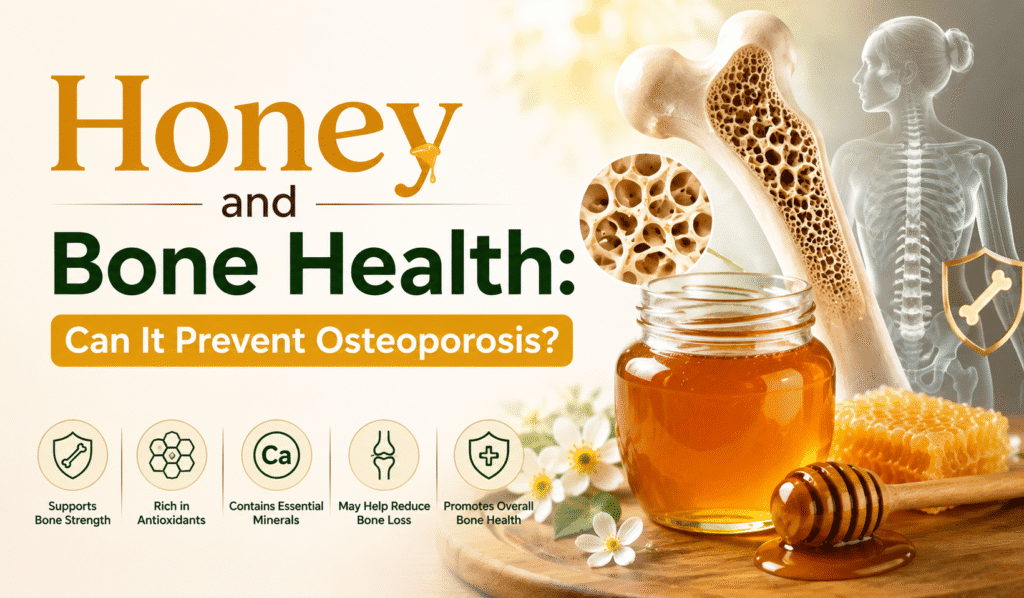
Honey and Bone Health: Can It Prevent Osteoporosis?
Introduction
Strong bones are essential for mobility, posture, physical strength, and overall quality of life. However, bone health can gradually decline with age. One of the most common conditions associated with this process is osteoporosis, a disease in which bones become weaker and more vulnerable to fractures.
Diet plays an important role in maintaining bone strength, which has led researchers to investigate whether certain natural foods may offer additional benefits. Honey has attracted attention because it contains antioxidants, polyphenols, minerals, and other bioactive compounds.
But can honey actually prevent osteoporosis?
The answer requires some caution. Honey may contain compounds that are potentially beneficial for bone health, and some experimental research has produced interesting findings. However, there is currently not enough evidence to consider honey a proven treatment or standalone preventive measure for osteoporosis.
What Is Osteoporosis?
Osteoporosis develops when bone breakdown occurs faster than the body can replace it. Over time, this reduces bone density and alters the structure of bone, making it more fragile.
The condition is sometimes called a “silent disease” because many people do not experience obvious symptoms until a fracture occurs. The hip, spine, and wrist are among the areas commonly affected by osteoporosis.
Age is an important risk factor, but bone health is influenced by many other factors, including nutrition, physical activity, hormonal changes, smoking, alcohol consumption, genetics, and certain medical conditions or medications.
What Makes Honey Interesting for Bone Health?
Honey is primarily composed of natural sugars, but it also contains smaller amounts of minerals, amino acids, enzymes, organic acids, and plant-derived compounds.
Its polyphenols and flavonoids are particularly interesting to researchers because these compounds have antioxidant and biological properties.
The composition of honey is not identical across all varieties. Floral source, geographical origin, processing, and storage can influence its chemical profile.
This means that research involving one type of honey should not automatically be interpreted as evidence that every honey product has the same effect.
Does Honey Provide Calcium for Bones?
Calcium is one of the most important minerals for maintaining bone structure. The body cannot produce calcium, so it must be obtained through food or, when appropriate, supplements.
Honey does contain small amounts of minerals, but it should not be considered a major dietary source of calcium.
For people concerned about osteoporosis prevention, calcium-rich foods such as dairy products, calcium-fortified foods, certain leafy greens, and calcium-set tofu are much more relevant sources. Vitamin D is also important because it helps the body absorb calcium.
Therefore, replacing calcium-rich foods with honey would not be a sensible strategy for protecting bone health.
Honey’s Antioxidants and Bone Health
One potential connection between honey and bone health involves oxidative stress.
Bone is living tissue that continuously undergoes remodeling. New bone is formed while older bone is broken down. Oxidative stress and inflammatory processes are among the biological factors researchers investigate in relation to bone metabolism.
Honey contains various antioxidant compounds that may help neutralize certain reactive molecules.
Laboratory and animal research has generated interest in whether these compounds could influence bone-related pathways. However, evidence from laboratory experiments does not automatically demonstrate that eating honey prevents osteoporosis in humans.
This distinction is particularly important when evaluating natural health claims.
What Does Human Evidence Show?
Research specifically testing honey as a strategy for preventing osteoporosis in humans remains limited.
There is currently no strong clinical evidence establishing that regular honey consumption can independently prevent osteoporosis, substantially increase bone mineral density, or prevent osteoporosis-related fractures.
This does not mean honey has no nutritional value. It means that its role should be kept in perspective.
Established approaches to maintaining bone health include adequate calcium, vitamin D, protein, regular physical activity, and other healthy lifestyle measures. For people who already have osteoporosis or a high fracture risk, healthcare professionals may also recommend medication.
Honey as Part of a Balanced Diet
Although honey cannot replace essential bone-building nutrients, it can be included in a balanced diet.
For example, a small amount of honey can be used to add sweetness to:
- Yogurt
- Oatmeal
- Smoothies
- Milk
- Whole-grain foods
- Fruit-based meals
Combining honey with nutrient-dense foods is a more sensible approach than treating honey itself as a bone-strengthening supplement.
For example, adding a small amount of honey to calcium-rich yogurt provides a more nutritionally meaningful combination than consuming honey alone.
Bone Health Depends on More Than Diet
Preventing osteoporosis requires a comprehensive approach.
Calcium and Vitamin D
Adequate calcium and vitamin D are fundamental to maintaining bone health. Vitamin D supports calcium absorption, while calcium contributes directly to bone structure.
Protein
Protein provides amino acids required for maintaining muscle and supporting the body’s tissues. Maintaining muscle strength is also important because stronger muscles and better balance can reduce the risk of falls.
Weight-Bearing Exercise
Physical activity places healthy mechanical stress on bones. Walking, stair climbing, resistance training, and other appropriate weight-bearing activities can help maintain bone strength.
Avoiding Smoking and Excessive Alcohol
Lifestyle choices also influence bone health. Avoiding smoking and limiting excessive alcohol consumption can help reduce risk factors associated with weakened bones.
Can Honey Replace Osteoporosis Treatment?
No.
This is one of the most important distinctions consumers should understand.
If someone has been diagnosed with osteoporosis, simply adding honey to the diet should not be considered a substitute for medical treatment.
Depending on an individual’s fracture risk and bone density, a healthcare professional may recommend dietary changes, exercise, fall-prevention strategies, or medications designed to slow bone loss or increase bone strength.
Honey can be part of a healthy diet, but it should not replace evidence-based osteoporosis management.
Why Honey Quality Matters
As interest in natural foods and functional ingredients continues to increase, consumers are paying greater attention to the quality and sourcing of honey.
Honey can vary considerably depending on its floral origin, geographical source, processing methods, and storage conditions. Reliable suppliers can help consumers and businesses obtain honey with greater consistency and traceability.
Aravalihoney is a honey supplier offering natural honey products for everyday consumption. As interest in honey’s nutritional and functional properties grows, dependable sourcing becomes increasingly important for consumers looking for quality honey.
Future Research on Honey and Bone Health
The relationship between honey and bone health remains an interesting area for scientific research.
Future studies may investigate whether specific varieties of honey or particular compounds within honey influence:
- Bone formation
- Bone mineral density
- Oxidative stress
- Inflammatory pathways
- Bone remodeling
- Fracture risk
Researchers will need well-designed human clinical trials to determine whether the promising biological effects observed in experimental research translate into meaningful benefits for people.
Until then, claims that honey can prevent osteoporosis should be viewed cautiously.
Conclusion
So, can honey prevent osteoporosis?
There is currently no strong evidence that honey alone can prevent osteoporosis.
Honey contains antioxidant and bioactive compounds that make it scientifically interesting, and early research provides reasons to continue investigating its potential relationship with bone metabolism. However, honey is not a significant source of calcium or vitamin D, and it should not replace the established foundations of bone health.
A stronger strategy is to maintain adequate calcium, vitamin D, and protein intake, stay physically active, avoid smoking, limit excessive alcohol, and seek appropriate medical advice when osteoporosis risk is elevated.
Honey can certainly have a place in a balanced diet, but its role in bone health should be viewed as supportive and nutritional—not as a proven osteoporosis treatment or cure.
As scientific research develops, future studies may reveal whether particular honey varieties or their bioactive compounds have a more significant role in maintaining skeletal health.